
Baker this, Baker that – who’s this Baker that gives the destination its name? His full name is Edward “Ned” Dickinson Baker, an army officer and U.S. senator in the mid 1800s.
From London to America
Baker was born in London into a Quaker family. They moved to Philadelphia when he was only five, and then to New Harmony, Indiana when he was 14, where the Bakers were part of a utopian community led by the social reformer Robert Owen.
Friend of Lincoln
As a young man, Baker became a lawyer and also began preaching. He became renowned for his stirring public speeches, which helped him win election to the Illinois state legislature. He went on to beat out none other than Abraham Lincoln to a seat in the U.S. House of Representatives. Despite this, Baker and Lincoln became friends and political allies (Lincoln named one of his sons after Baker).
Baker’s involvement in both Congress and the U.S. Army caused some controversy. He eventually left Congress because the U.S. Constitution forbids army officers from serving as representatives. As an army colonel, Baker fought in the Mexican-American War before quitting the army and returning to politics. This time, Baker represented San Francisco, California, where he operated a law practice. His rhetorical skills made him a compelling speaker in front of juries, but he was bad with details and his practice was very disorganized.
Baker makes it to Oregon
When Baker lost his seat as a U.S. representative, he moved to Oregon, where he had friends from his time in Illinois. He moved to Salem in 1859, one year before the start of the Civil War. As a staunch Republican opposed to slavery, Baker met opposition in his bid to represent Oregon in the U.S. Senate, but he won election and assumed office in December 1860, a few months before Lincoln was inaugurated as the 16th president.
Baker’s friendship and alignment with Lincoln caused many to think Baker might get a seat in Lincoln’s cabinet. But Baker’s support and vote in the Senate was so crucial to the anti-slavery movement that he never got a cabinet position.
Baker and the Civil War
The Civil War began a few months later, in April of 1860. Baker recruited soldiers at the war’s onset to protect Washington D.C. Even though it got him into trouble before, Baker again assumed his role as a colonel in the Union army while still representing Oregon. During the Battle of Balls Bluff in Virginia, Baker was killed by Confederate bullet-fire. To this day, Baker is the only active U.S. Senator to be killed in the line of fire.
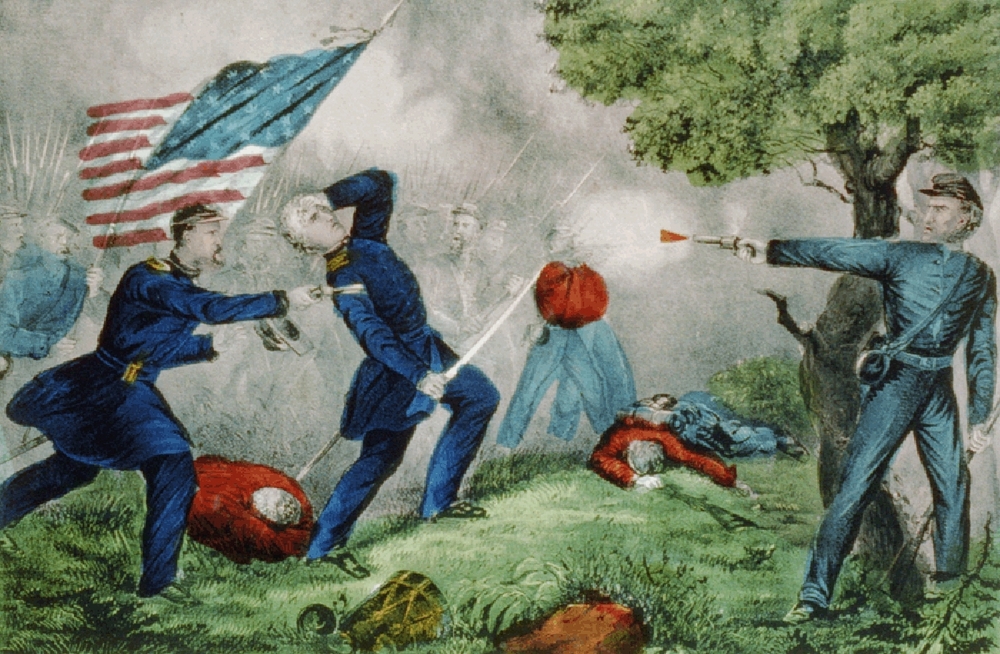
“Death of Col Edward D. Baker: At the Battle of Balls Bluff” – Library of Congress
Did Baker ever actually make it to Baker City or County? No one knows for sure. The county was created in 1862, so Baker’s death (and political loss for Oregon) remained fresh at the time of the county’s incorporation. it would take another 12 years before Baker City was officially incorporated, with around 300 residents, and the population only really grew significantly once the railroad came through in the 1880s.
Baker City, Oregon and Mt. Baker, Washington
Mt. Baker, a snow-covered volcano in the North Cascades of Washington state about 500 miles away, is not named after Senator Baker. Instead, the mountain, which has been known as Kwelshán by the indigenous Nooksack people, was named by Captain George Vancouver after Joseph Baker, an officer in the British Royal Navy and part of the Vancouver expedition that mapped the Pacific Northwest about 60 years before Senator Baker’s death during the Civil War.