

Quilting has been an essential skill of american households for centuries. The technique of joining smaller pieces of fabric together allowed families to repurpose old or small pieces of fabric and making something new and beautiful.
As a celebration of the art of quilt-making, many communities across the country hang representations of quilt block designs on barns and other outdoor places. These celebrations of culture and craftsmanship have taken on a life of their own across the East Coast, where many quilt block trails dot the historic communities of Colonial America. Here in Oregon, the Pine Valley Quily Block Trail joins a few other trails to bring this celebration of tradition to the Pacific Northwest.
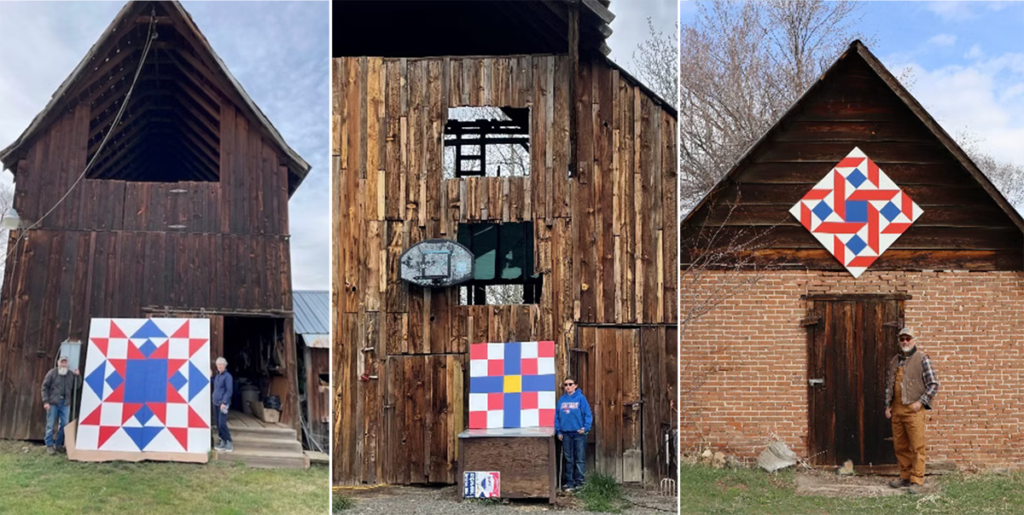
Although new to Pine Valley, quilt trails have been appearing in towns across the U.S. since the early 2000s. Described as “a series of painted wood or metal hung or freestanding quilt squares installed along a route emphasizing significant architecture and/or aesthetic landscapes,” quilt trails originated in Ohio and can now be found in more than 30 states and several Canadian provinces.
In Oregon, the Tualatin Valley Quilt Barn Trail features 60 blocks; there are 52 blocks on the Tillamook County Quilt Trail; and 46 appear on the Bridge of the Gods Quilt Block Trail in Cascade Locks. Halfway now joins this esteemed group with 21 art boards at 18 locations throughout Pine Valley. Most are located on or near paved roads for easy access and viewing.
The project started shortly after Lorence and her husband, Walt, moved to Pine Valley and she became enamored with the many old barns in the area. Lorence had been involved in the Tualatin Valley Quilt Barn Trail when she lived in Washington County and thought a similar project could also be successful here. She organized a community meeting in the fall of 2021 and from that gathering emerged the initial participants in Pine Valley’s Quilt Block Trail.
The very first barn quilts were painted directly on the surface of the structure, but the work was so labor-intensive that painters began creating the quilt blocks on pieces of wood instead. A full-sized barn quilt is eight feet by eight feet, requiring two sheets of plywood mounted side by side; however, a few of the pieces in Pine Valley’s Quilt Block Trail are four feet by four feet due to structural or other limitations. For example, the Pine Valley Grange has three four-by-four boards as there is not enough room for an eight-by-eight on their building.
Transferring complicated quilt patterns to paper and then plywood is an exacting, time-consuming process. It’s followed by carefully outlining each section of the quilt with painter’s tape before layers upon layers of color are applied. “It takes between 30 and 56 hours to design and paint an eight-by-eight quilt,” Lorence said.
Quilt blocks traditionally do not include any advertising or logos, and Lorence worked hard to adhere to this practice for the Pine Valley project. There turned out to be a couple of minor exceptions, including the traditional wheat symbol which appears on one of the Grange boards. Many Pine Valley quilt blocks are painted red, white and blue, a proud sign of local patriotism, and most of the local patterns hold significant historical or personal meaning. The Martha Washington Star on Angela and JP Binford’s barn embodies their marriage and faith; the Arrow Star on Kellee and Tom Ford’s barn incorporates the Native American symbol for happiness; and Pharlemina’s Favorite, a family pattern, is going on the barn at Mehlhorn Century Farm. A directionaly-correct Compass highlights Tobie Willmarth’s barn; the Lonesome Dove, a symbol of faith and also a favorite TV show, is featured on Mike and Margie Knode’s barn; and the Drunkard’s Path pattern chosen by Richard and Marilyn Seal was copied from an actual family quilt.
The task of hanging the actual blocks can be complicated by the size and weight of the plywood, the orientation of the artwork and the height and condition of each barn or building. Most of the local barns were built in the early 1900s and, while many have been well-maintained, others are in need of care and refurbishing. Early construction methods and features such as angled rooflines, aging pine wood, bat and board siding, perlin bracing, door and window cutouts, and heavy steel hardware dictate exactly where and how each block can be affixed.
Interestingly, most of the barns were placed on stone piers and left open to the ground to accommodate runoff from flood irrigation. The majority are positioned north-south to avoid prevailing winds and many are left unfinished or painted red – with the notable exception of the pristine white structures on the Mehlhorn Farm.
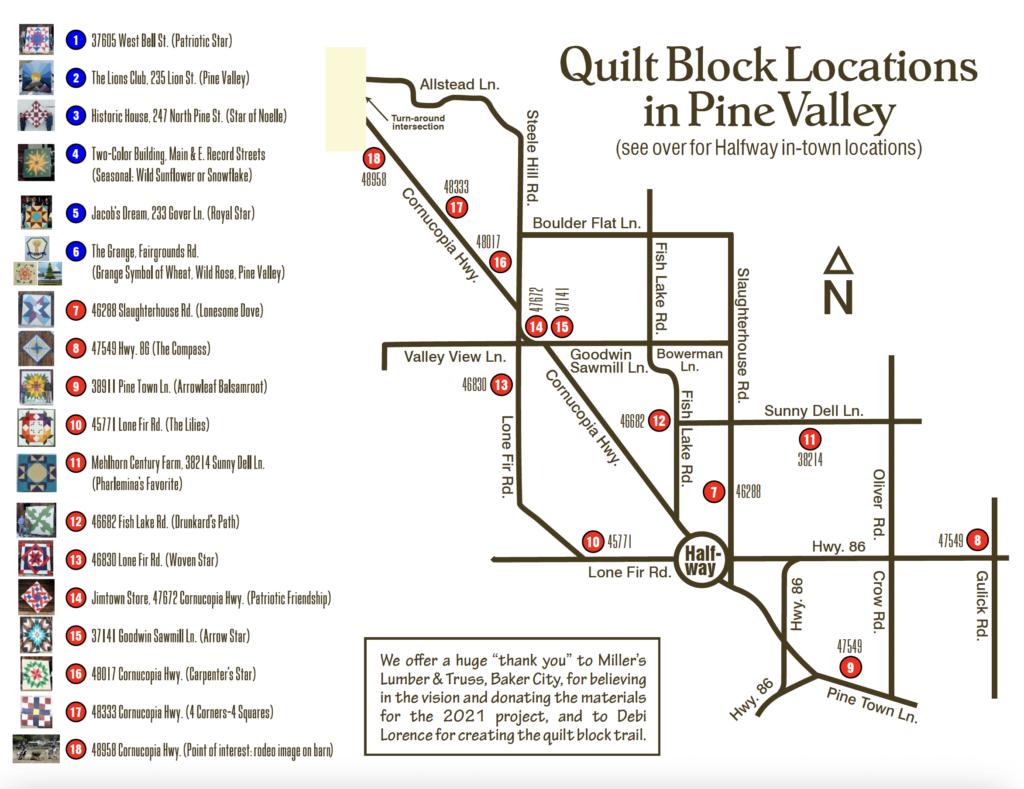
A key feature of every quilt trail – in addition to the historic buildings upon which the blocks are displayed and the blocks themselves, many with a history of their own – is a self-guided tour map that allows people to visit the different locations at their own time and pace.